 Save
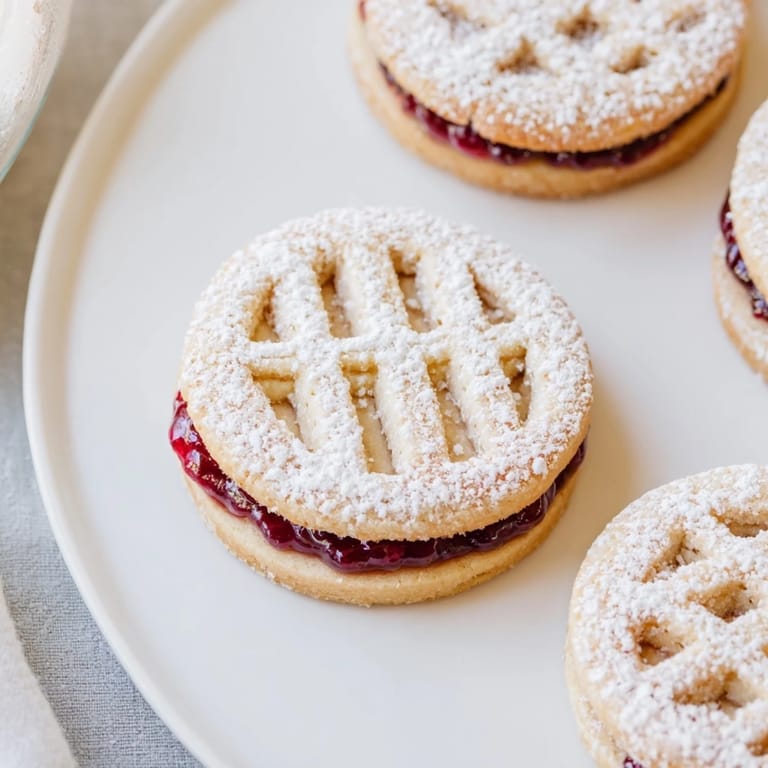
Save There's something about Austrian baking that stops time. Years ago, a friend's grandmother handed me a tin of Linzer cookies at Christmas—those delicate butter rounds with their jewel-like centers of ruby jam peering through a lattice window—and I understood why people traveled across Vienna just to buy them. The buttery snap, the tartness of the jam, the whisper of cinnamon and almond: it felt less like a recipe and more like a secret passed down. I had to learn to make them.
The first time I made these for a small gathering, I was nervous about the lattice cutouts—worried the dough would tear or look amateur. But as they came out of the oven, golden and perfect, and I dusted them with powdered sugar, my friend leaned over and said they looked like they belonged in a Vienna café. That moment changed how I approach baking: precision matters, but the joy is in trying.
Ingredients
- All-purpose flour (2 cups / 250 g): The foundation that keeps these cookies tender rather than dense, balancing the richness of the butter.
- Blanched almond flour (1 cup / 100 g): Ground finely, it adds a delicate nuttiness and keeps the texture sandy rather than tough—don't skip the blanched version or you'll get speckles.
- Ground cinnamon (1/2 teaspoon): A whisper, not a shout; it plays beautifully with both jam and almond.
- Salt (1/4 teaspoon): Tiny but essential—it lifts every other flavor and prevents the dough from tasting flat.
- Unsalted butter, softened (3/4 cup / 170 g): Room temperature is non-negotiable; cold butter won't cream properly and you'll lose that light, airy texture.
- Powdered sugar (2/3 cup / 80 g for dough, plus 1/4 cup / 30 g for dusting): The fine sugar dissolves into the butter, creating that signature tender crumb.
- Egg yolk (1 large): Just the yolk binds the dough together without making it tough—the white would add water and toughness.
- Pure vanilla extract (1 teaspoon): Real extract, not imitation, makes the difference in something this delicate.
- Grated lemon zest (1/2 teaspoon): A bright note that doesn't announce itself but makes the whole cookie feel more alive.
- Seedless raspberry jam (3/4 cup / 225 g): Choose quality jam with visible fruit; thin, sugary jam will seep through the lattice and dissolve your careful windows.
Tired of Takeout? 🥡
Get 10 meals you can make faster than delivery arrives. Seriously.
One email. No spam. Unsubscribe anytime.
Instructions
- Build your dry mix:
- Whisk together flour, almond flour, cinnamon, and salt in a medium bowl. This combines everything evenly before you add it to the butter, so you avoid overmixing later.
- Cream butter and sugar:
- Beat softened butter with powdered sugar until it's pale and fluffy, about 2 to 3 minutes. You're adding tiny air bubbles that make the final cookie tender and delicate.
- Build the dough:
- Add the egg yolk, vanilla, and lemon zest and beat until combined. The yolk should disappear into the butter, and the mixture should smell bright and vanilla-forward.
- Bring it together gently:
- Add your dry mix gradually, stirring with a spatula just until the dough comes together. Overmixing develops gluten and makes the cookies tough—stop as soon as you don't see any flour streaks.
- Chill the dough:
- Divide into two disks, wrap in plastic, and refrigerate for at least 1 hour. Cold dough is easier to roll and keeps those sharp lattice edges from blurring.
- Prepare your workspace:
- Preheat the oven to 350°F (175°C) and line two baking sheets with parchment paper. A cold oven won't bake them evenly.
- Roll with confidence:
- On a lightly floured surface, roll one dough disk to about 1/8 inch thickness. The dough should be cool; if it's warming up and sticking, pop it back in the fridge for 10 minutes.
- Cut the bottoms:
- Using a 2-inch round or fluted cutter, cut out as many cookies as you can. Place these on your prepared baking sheets—these are your solid bottoms.
- Create the windows:
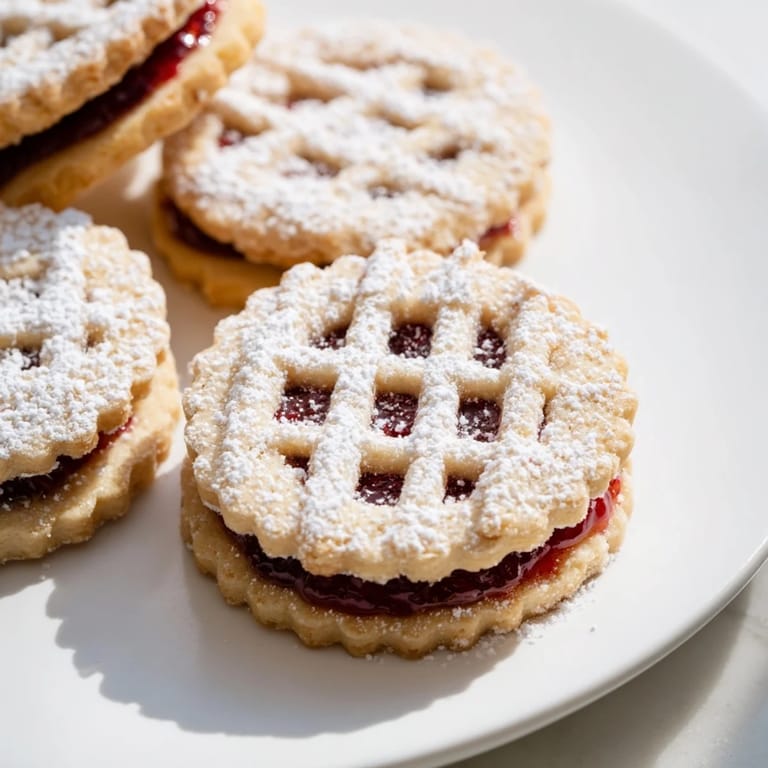
- Using the same cutter, cut out more cookies from the remaining dough. Then use a 1-inch cutter to remove the centers of these second batch, creating rings with windows or lattice patterns.
- Gather and re-roll:
- Gently collect all your scraps, press them together, and re-roll. You'll usually get another round of cutouts, so waste is minimal.
- Bake until golden:
- Bake for 10 to 12 minutes until the edges are lightly golden but the centers still feel soft. They'll firm up as they cool, so pull them out when they look barely done.
- Cool with patience:
- Let them rest on the pan for 2 minutes (they're still setting), then transfer to a wire rack to cool completely. Stacking warm cookies creates steam and softness.
- Dust the tops:
- Once completely cool, dust the top cookies (the ones with cutouts) generously with powdered sugar. This gives that jeweled, elegant look.
- Fill with care:
- Spread about 1 teaspoon of raspberry jam on the flat side of each bottom cookie. A little goes a long way; too much and it squeaks out the sides.
- Sandwich together:
- Place the sugared tops over the jam, pressing gently. The powdered sugar will stick slightly to the jam and help hold everything together.
- Let them set:
- Allow at least 30 minutes of rest before serving so the jam firms up and the sandwich holds its shape when bitten into.
 Save
Save I learned the hard way that these cookies deserve respect and patience. The first batch I made, I was impatient—didn't chill long enough, rolled too thick, filled too generously. They came out puffy and jam-legged across the baking sheet. The second attempt, I slowed down, and suddenly I understood why these little cookies have been beloved for generations.
The Magic of Almond Flour
Almond flour is what transforms these from ordinary butter cookies into something refined and European. It adds a subtle richness and a tender crumb that all-purpose flour alone can never achieve. The blanching is important—it removes the papery skin and keeps your dough pale and delicate instead of speckled. If you can only find unblanched almond flour, sift it first to remove what skins you can, or make peace with a slightly darker, still-delicious result.
Jam: The Star of the Show
This recipe lives or dies by the quality of your jam. A thin, overly sweet commercial jam will weep through your lattice and become murky. Seek out a jam with visible fruit and good pectin structure—it should hold its shape when spooned. Homemade jam is glorious, but a good European preserve works beautifully too. If you want to experiment, apricot jam is elegant, and blackcurrant brings a sophisticated tartness that some prefer to raspberry.
Storage and Serving Suggestions
These keep beautifully in an airtight container for up to five days, though they're at their absolute best on day one and two when the contrast between crisp cookie and set jam is still pronounced. Pair them with a glass of dessert wine, hot tea, or even champagne if you're feeling celebratory. They're the kind of cookie that makes people slow down and savor rather than gobble.
- If storing for more than a day, keep them in a single layer separated by parchment to prevent sticking.
- You can make the unbaked dough disks weeks ahead and freeze them, baking as needed for fresh cookies on demand.
- These travel well in a box lined with parchment, making them perfect for holiday gifts or potlucks.
 Save
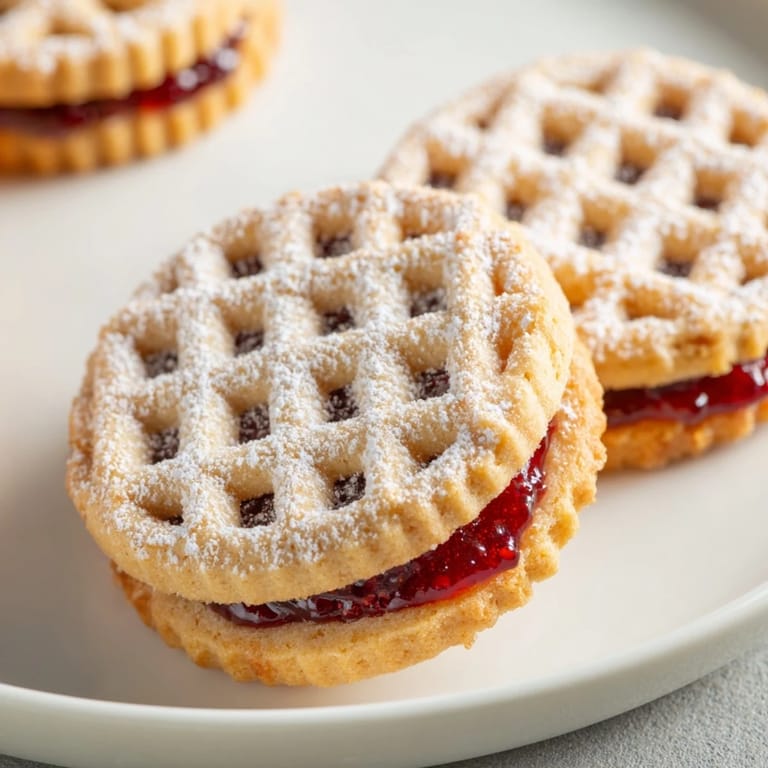
Save Every time I make these, I'm grateful for the friend's grandmother who shared them first, and for the way a recipe can carry a story across generations. There's something deeply satisfying about creating something so beautiful and delicate with your own hands.
Recipe FAQs
- → What makes these cookies tender?
The combination of softened butter, almond flour, and a short chilling period helps create a tender, crumbly texture.
- → Can I substitute raspberry jam with another flavor?
Yes, apricot or blackcurrant jams work well as alternatives, offering different fruity notes that complement the almond base.
- → How thick should I roll the dough?
Roll the dough out to about 1/8 inch (3 mm) thickness to ensure even baking and the ideal texture.
- → Why is chilling the dough important?
Chilling firms the dough, making it easier to roll and cut, and helps the cookies maintain their shape during baking.
- → Can the almond flour be replaced for nut allergies?
Yes, for a nut-free version, replace the almond flour with additional all-purpose flour, although texture and flavor will vary.